1215
Magna Carta
After losing the duchy of Normandy to the French in 1204, John tried and failed to regain it. This provoked a rebellion by his barons that destabilised the kingdom.1 The National Archives says Magna Carta was sealed by King John in 1215, and that its emphasis on liberty — and the principle that the ruler is subject to the law — has resonated down the ages.1 Britannica calls Magna Carta a charter of English liberties granted by King John on June 15, 1215, under threat of civil war and reissued, with alterations, in 1216, 1217, and 1225.2
King John and the barons famously sealed their agreement, later known as Magna Carta, at Runnymede on 15 June 1215. Four days later its terms were published.1 On June 15, 1215, the document known as the Articles of the Barons was at last agreed upon, and to it the king's great seal was set.2 The final version of the Magna Carta was accepted by the king and the barons on June 19.2
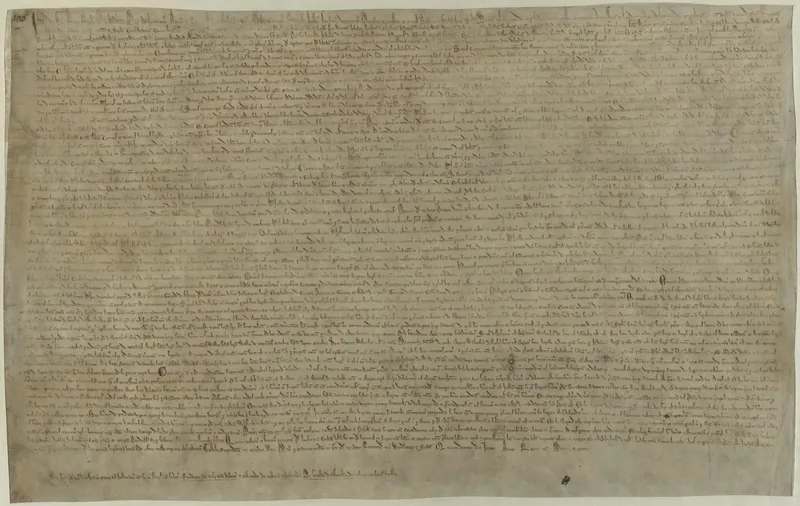
Among the liberties conceded, no free man would be arrested, imprisoned, outlawed or exiled without the lawful judgement of his peers or by the law of the land.1 By declaring the sovereign to be subject to the rule of law and documenting the liberties held by “free men,” it provided the foundation for individual rights in Anglo-American jurisprudence.2
English Heritage says John's barons forced him to sign Magna Carta, which was intended to limit his powers, in 1215 — but ultimately he ignored it.3
Sealed, or signed?
The National Archives says King John and the barons sealed their agreement at Runnymede on 15 June 1215, and that its terms were published four days later. Britannica says the Articles of the Barons had the king’s great seal set to them on 15 June, and that the final version was accepted on 19 June; it also uses the word “granted.” English Heritage’s introduction says John’s barons forced him to sign Magna Carta in 1215. “Sign” is the wording on that page. The other two sources we checked describe a seal, not a signature, so we keep both in view and do not treat “King John signed it” as settled wording.
It did not settle things at once
After agreeing the charter, King John quickly disowned these written rights.1 John died in October 1216, with his nine-year-old son, Henry, assuming the throne in the midst of French invasion.3 Louis conquered almost all of south-eastern England (though not Dover Castle), but retreated in 1217 after defeats in the Battle of Sandwich and in the streets of Lincoln.3
By 1225, Henry III, ruling in his own right, reissued a slightly revised Magna Carta. The 1225 Magna Carta became the definitive version.1 The 1297 Magna Carta is the version which was placed onto the Statute Book.1
There still exist four original copies of the charter of 1215, two of them held by the cathedral churches in which they were originally deposited — Lincoln and Salisbury — and the other two in the British Library.2
Henry III's later reign saw baronial unrest headed by Simon de Montfort, who died at the Battle of Evesham (1265).3